

Articles (English Grammar)
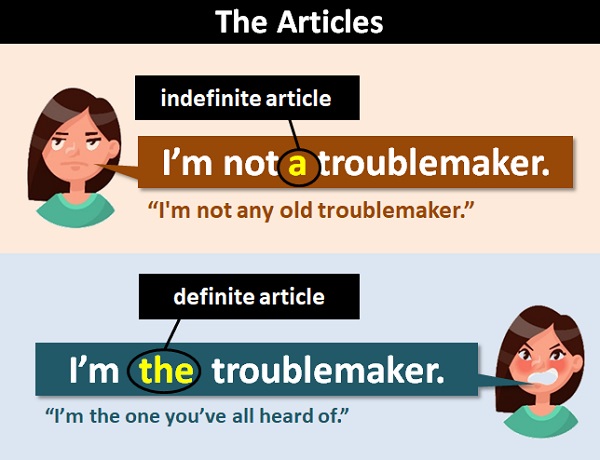
The articles are the words “a,” “an,” and “the.” They define whether something is specific or unspecific. There are two types of article:
(1) The Definite Article (The). “The” is called the definite article. It defines its noun as something specific (e.g., something previously mentioned or known, something unique, something being identified by the speaker).
- This is the lake.
(2) The Indefinite Article (A, An). “A” and “an” are called the indefinite articles. They define their noun as something unspecific (e.g., something generic, something mentioned for the first time).
- This is a lake.
Infographic Explaining the Two Types of Article
The Two Types of Article
Key Takeaway
“The” is called the definite article because it is used to indicate something specific. “A and an” are called the indefinite articlesbecause they are used to indicate something unspecific.Also of note, articles are classified as determiners. A determiner sits before a noun to indicate quantity, possession, specificity, or definiteness.
Read more about determiners.Got it? Take a quick test.
Examples of the Definite and Indefinite Articles
Here are some more examples of the articles in use:
- I fell over the chair again.
- Can you pass me a chair?
- I loved the apple pie after the meal.
- I love an apple pie after dinner.
Articles Go before Adjectives
An article often modifies a noun that is already being modified by an adjective. When this happens, the article goes before the adjective (or adjectives). For example:
- Please open the small box first.
- You will get an excellent pizza at Papa Antonio’s.
Indefinite Articles Are Used with Singular Nouns
The indefinite article (a, an) is only for singular nouns. It is not used for plural nouns.
As the indefinite article specifies one thing (e.g., a cup means one cup), it is not used with non-countable nouns (e.g., water, air, integrity). For example:
- I need an air.
- Play me a music.
- Give me a heat.
Most commonly, the indefinite determinersome is used instead.
Articles Are Not Used with Possessive Determiners or Possessive Pronouns
Articles are not used with possessive determiners (my, your, his, her, its, our, their) or possessive pronouns(mine, yours, his, hers, ours, theirs) as these already show that something is specific. For example:
- Take me to the your leader.
- Take me to your leader.
- Can I borrow a yours?
- Can I borrow yours?
Why Should I Care about Articles?
Here are two common questions related to articles.
(Question 1) When Do You Use “An” and “A”?
The most common mistake involving articles is using “an” instead of “a” (or vice versa). This mistake occurs because writers believe “an” is used before a vowel and “a” before a consonant. That is not entirely accurate. “An” is used before a vowel sound, and “a” is used before a consonant sound. The word sound is important because consonants can create vowel sounds, and vowels can create consonant sounds. Therefore, the use of “an” or “a” is determined by the sound not the letter. Look at these examples:
- A house
- An hour
- A uniform row
- An unidentified man
Be especially careful with abbreviations:
- An MOT
- An LRS
- A US diplomat
(Question 2) Do you say “an historic moment” or “a historic moment”?
The words historic, historical, historian, horrific, and even hotel are worthy of special mention because they are often spoken and written with the wrong version of the indefinite article. All of these words start with a consonant sound, as soft as it might be. Therefore, their article is “a” not “an.”
- The attraction of power can be a disease, a horrific disease. (Irish actor Liam Cunningham)
- We owe an historic debt to American Indians. They have a unique set of concerns that haven’t been addressed. (American politician Alan Franken)
Here are two other issues related to the articles.
(Issue 1) Writing a job title or an office name with a capital letter.
A job title (e.g., president, judge, director) or the name of an office (parliament, court, accounts section) is given a capital letter when it refers to a specific person or office, i.e., when it’s a proper noun. So, when the definite article (i.e., “the”) appears before such a title or name, there’s a pretty good chance you’ll need a capital letter.
Here’s the guidance: If the job title or office name is being used for its dictionary definition, i.e., as a common noun, then don’t use a capital letter. However, if the job title or office name nails it down to one specific person or office, then use a capital letter. Look at these examples:
- The King was a king among kings.
- The Prime Minister said: “Being a prime minister is a lonely job…you cannot lead from the crowd.” (Prime Minister Margaret Thatcher).
- (The Prime Minister specifies an individual, but a prime minister does not.)
(Issue 2) Capitalizing “The” when it starts a name (e.g., The Beatles).
Some names (particularly band names) start with “The” (e.g., The Beatles, The Rolling Stones, The Sex Pistols). When such names appear in running text, you have a choice whether to write “The” (with a capital letter) or “the.” There’s no consensus among the leading style guides on this point, so go with your preference.
- Did you download the The Clash album?
Bear in mind that you might stumble across this issue with foreign names.
- Gina Vitale: The restaurant is called “The La Trattoria.”
- Michael Felgate: “The La Trattoria” means The The Trattoria.
- Gina Vitale: I know.
- Does it disturb anyone else that “The Los Angeles Angels” baseball team translates directly as “The The Angels Angels”? (Anon)
Key Points
- Use “an” before a vowel sound and “a” before a consonant sound. (Note the word sound.)
- If you’re drawn to “an historic” or “an horrific”, give your aitches more “huh” until you’re comfortable with using “a.”
- When a job title (e.g., ambassador) or an office name (e.g., finance office) is preceded by “an” or “a” (as opposed to “the”), write it with a lowercase letter.
Interactive Exercise
Here are three randomly selected questions from a larger exercise, which can be edited, printed to create an exercise worksheet, or sent via email to friends or students.
Q1
Select the correct version.A: an historical siteB: a historical site
Q2
Select the correct one:A: An antelopeB: A antelopeC: An leopard
Q3
Select the definite article:A: AB: AnC: The
Take a different test on articles.Take a test on using “an” and “a” correctly.Help Us To Improve Grammar Monster
- Do you disagree with something on this page?
- Did you spot a typo?
Please tell us using this form.
See Also
What is the definite article?What is the indefinite article?What are adjectives?What are vowels?What are consonants?Glossary of grammatical terms


Technical Help
Download a Free Grammar Checker
Download Grammarly’s app to help with eliminating grammar errors and finding the right words.
(The Grammarly app works with webmail, social media, and texting apps as well as online forms and Microsoft Office documents like Word.)
Self Help: Buy Our Book
“Smashing Grammar” (2019)
Written by the founder of Grammar Monster, “Smashing Grammar” includes a glossary of grammar essentials (from apostrophes to zeugma) and a chapter on easily confused words (from affect/effectto whether/if). Each entry starts with a simple explanation and basic examples before moving to real-life, entertaining examples. All entries conclude with a section highlighting why the grammar point is relevant for a writer and top-level bullet points summarizing the entry. [More…]“Grammar for Grown-ups” (2011)
Vocational rather than academic, “Grammar for Grown-ups” is packed with real-life examples and keeps you engaged with a wealth of great quotations from Homer the Greek to Homer the Simpson. Straight talking and methodical, Craig Shrives draws on his years compiling Grammar Monster and as an army officer to present a comprehensive but light-hearted and easily digestible grammar reference guide. [More…]
Free Help
Everything on Grammar Monster is free.
Grammar GlossaryCommon Grammar ErrorsPunctuation LessonsTests
More free grammar help…Twitter (daily tips)Facebook (daily tips)YouTubeEmail tips (weekly)
…or join our Facebook group and ask a grammar question.
 Site Title